
The Indian economy is likely to grow at over 7 per cent in the current fiscal year, former Niti Aayog vice chairman Arvind Panagariya said on Wednesday, while observing that the growth rate should sustain next year too provided the forthcoming Budget does not have any negative surprises. Panagariya further said recessionary fears have been around for a while but so far neither the US nor the EU has gone into recession. "From the viewpoint of India, in terms of headwinds originating abroad, the worst is probably behind us," he told PTI.

The Fed's decision on tapering its monthly $85 billion bond-buying programme is expected later on Wednesday.

The next policy meeting will be in mid-June, when the panel will be joined by Stanley Fischer, the former Bank of Israel governor whose nomination to the Fed's board was confirmed on Wednesday by the US Senate.

In a speech to the National Economists Club that echoed dovish comments by his nominated successor, Janet Yellen, Bernanke also said that while the economy had made significant progress, it was still far from where officials wanted it to be.

Global liquidity expected to continue amid ECB stimulus

Among the Sensex firms, IndusInd Bank, Tata Steel, Tata Motors, Sun Pharma, Infosys, Mahindra & Mahindra, Infosys, NTPC, Bharti Airtel, HCL Technologies and Axis Bank were the biggest gainers. Tech Mahindra and Bajaj Finance were the laggards.

Global trends, macroeconomic data, and the outcome of the US Fed policy meeting are the major factors that will drive the movement in the domestic equity markets this week, analysts said. "In the upcoming data-centric week, the focus will be on crucial releases, including inflation data from India and the US. "Indian inflation is expected to rise, while US inflation will remain steady.

The chances of a rate cut in September have risen.
.jpg)
The partially convertible rupee closed at 63.37/38 per dollar compared with 62.83/84 on Monday. The unit dropped 0.85 per cent on the day, its biggest single-day fall in two weeks.

The majority in the markets believe that a September lift-off is likely.

Kerala pumpkin curry has to be the best way to eat kadu. And ever tried an imli-ginger relish?

Even if the central bank doesn't pull the trigger later, it is still expected to by the end of the year.

The recession-hit US economy has been witnessing signs of revival in recent months especially with the rate of economic contraction slowing down.

India's prices are rising faster than many of its emerging market peers. The country's inflation print for May at 4.25 per cent is a marked reduction from the levels seen in May 2022 (7.04 per cent). However, even though the inflation rate remains within the Reserve Bank of India's medium-term target of 4 per cent, with a 2 per cent margin on either side, it continues to be higher than China, Russia, and Brazil.

Summers dogged by controversies over past views

Of the eight RBI governors who have held office since the 1991 economic liberalisation, Bimal Jalan had the longest stint and S Venkitaramanan, the shortest. Current Governor Shaktikanta Das will overtake Bimal Jalan before completing his second term in December, points out Tamal Bandyopadhyay.

Gold is an excellent asset class for diversification and should be included in all long-term portfolios.

The Fed has prepared the world very well for a rate hike. In fact the market may have priced in a 25 basis points increase. So if the increase is 50 basis points, the reaction could be stunning, but a 25 basis points rise is not likely to have any great impact, says P V Subramanyam.

There will very little direct impact from the US Fed's rate hike this time, as we are well prepared both to handle liquidity, outflow of FII funds and managing our currency. But that doesn't mean India will be out of the woods anytime soon, says M V Subramanian.

Modi, on his maiden visit to the UNESCO World Heritage Site, first took the elephant safari in Mihimukh area of the Central Kohora Range of the park followed by the jeep safari inside the same range.

Indian stock markets are expected to be driven mostly by global factors this week amid a lack of local triggers and earnings season largely coming to an end, say analysts. Crude oil prices, rupee movement and US Federal Reserve meeting minutes to be released this week will also influence the market sentiment. "With the earnings season behind us, global cues would largely dictate the trend in the coming week," Ajit Mishra, SVP - technical research, Religare Broking Ltd, said.

Elevated food price-led inflation could become a sore point for markets, which they seem to be ignoring at current levels, observe analysts. Retail inflation in India - as measured by the Consumer Price Index (CPI) - came in at a three-month high of 6.52 per cent in January 2023, compared with 5.72 per cent in December and 5.88 per cent in November 2022. The inflation print for February, according to Madan Sabnavis, chief economist at Bank of Baroda, will be critical for the Reserve Bank of India's monetary policy committee.

India is better prepared to deal with any further US Fed tapering, but the country needs to remain vigilant to face eventualities, Reserve Bank Governor Raghuram Rajan said.

The US Federal Reserve's interest rate decision, global cues, macroeconomic data announcements and the ongoing quarterly earnings are the major triggers that will dictate trends in stock markets this week, analysts said. Besides, the trading activity of foreign investors and the movement of global oil benchmark Brent crude will also be tracked. "All eyes are on the outcome of the US Federal Reserve meeting scheduled for November 1, particularly due to the multi-year high levels of the US bond yields.

The US Federal Reserve has raised its benchmark interest rate by 0.25 per cent, only the second increase in a decade.

Investors' wealth fell by Rs 2.89 lakh crore in two days of market fall, with the BSE Sensex tumbling 796 points on Wednesday, amid weak global market trends ahead of the US Federal Reserve's interest rate decision. Fresh foreign fund outflows and caution ahead of a host of interest rate decisions from global central banks also added to the overall bearish trend. Besides, the US Fed meeting, the BoE (Bank of England) and the BoJ (Bank of Japan) are also scheduled to meet this week.

Foreign portfolio investors' (FPIs') net investments in the domestic debt market surged in December, marking a 77-month high, that is, since July 2017. According to market participants, this significant uptick in FPI inflows can be attributed to the post-domestic policy outcome and the US Federal Reserve's dovish stance at the December policy. FPI inflows into debt stood at Rs 18,393 crore in December against Rs 14,106 crore in November, according to data on the National Securities Depository Limited.
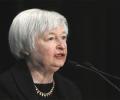
She will replace Ben Bernanke as the Chair of the Federal Reserve.

'With China falling out of favour, India is where investors see the demographic and digital dividend apart from the benefits of reforms playing out.' 'Your prime minister has also done a great job of sharing this story with the world.'
Gold prices on Wednesday sky-rocketed by Rs 340 at Rs 11,510 per ten gram as investors directed their money to the precious metal after the dollar fell, sparked by Federal Reserve cutting key interest rates.
The cut is being seen as an emergency measure to boost the US economy.

Markets end in red; bluechips struggle to keep pace.

Global financial markets are wrong in hoping that the worst is over in geopolitical crises such as the Iran-Israel conflict and the Russia-Ukraine war, wrote Christopher Wood, global head of equity strategy at Jefferies, in a recent note to investors called 'GREED & fear'. While most investors and the media are focused on United States (US) Federal Reserve policy and the "endless chatter" of Fed governors, Wood believes the news flow in the financial sphere "pales into complete insignificance" compared with the "tectonic shifts" going on in geopolitics.
The Federal Open Market Committee's statement after meeting in Washington said inflation has been "elevated" and remains a risk, using words identical to the last decision on June 29.\n\n

Wipro was the biggest loser in the Sensex pack, slipping nearly 2 per cent, followed by IndusInd Bank, State Bank of India, Kotak Mahindra Bank, ICICI Bank, HDFC Bank, Infosys, Tata Consultancy Services, HDFC and Bajaj Finserv. On the other hand, Nestle, Mahindra & Mahindra, ITC, HCL Technologies, Asian Paints and Maruti were among the gainers.
The gold and crude oil prices, which have risen to records this year, may ease a little if the US central bank Federal Reserve cut rates at its meeting on Tuesday, an analyst said.The Fed is scheduled to meet today to consider revision of interest rates. The US banking sector regulator has already cut the rate at which it lends to banks by 0.25 per cent to 3.25 per cent at an emergency weekend meeting on Monday.

While the markets have factored in a number close to 350 for the BJP and almost 400 for the NDA, 50 seats fewer could trigger a market correction

US gold futures slid over 1 per cent on Thursday, while silver futures dropped 2 per cent.

A weak dollar overseas also aided the rupee rise while fresh sell-off by foreign funds in domestic stocks capped the currency's gains, forex dealers said.
